

Home › Articles & guides › Lithium Battery Fires: What Your Business's Fire Extinguisher Setup Needs to Include
Safety
⏱ 7 min read
📅 Updated Jun 2026
Workplace Health & Safety
Home › Articles & guides › Lithium Battery Fires: What Your Business's Fire Extinguisher Setup Needs to Include
SAFETY GUIDE
Local WA Technicians Industry Leading Digital Reports Trusted by over 600 WA Businesses Licensed & Insured Competitive Local Rates
Lithium battery fires are different to conventional electrical or combustible fires and are one of the fastest growing fire risks across Perth workplaces and homes. Unlike standard fires, lithium-ion batteries can enter what is known as “thermal runaway”, where the battery rapidly overheats and creates an uncontrollable chemical reaction inside the cells. Once this occurs, the battery can produce extreme heat, violent flare ups, toxic gases, and repeated re-ignition even after the fire appears to be extinguished. These fires burn hotter and spread much faster than typical electrical fires, making them far more difficult to control with standard firefighting equipment.
The risk is increasing across Perth due to the widespread use of lithium batteries in power tools, emergency lighting systems, laptops, e-scooters, solar battery storage systems, and electric vehicles. High ambient temperatures commonly experienced in Western Australia can also place additional stress on lithium battery systems, particularly where batteries are poorly ventilated, damaged, incorrectly charged, or not maintained in accordance with manufacturer recommendations.
In this article:
IS YOUR FIRE EQUIPMENT LITHIUM-READY?
PTTS can review your current fire protection setup and confirm whether it covers your lithium battery risks.
or call 08 6109 8591
To understand your business's lithium fire risk, you first need to know which fire class applies. The classification depends on the form of lithium involved, and using the wrong extinguisher can make the situation significantly more dangerous.
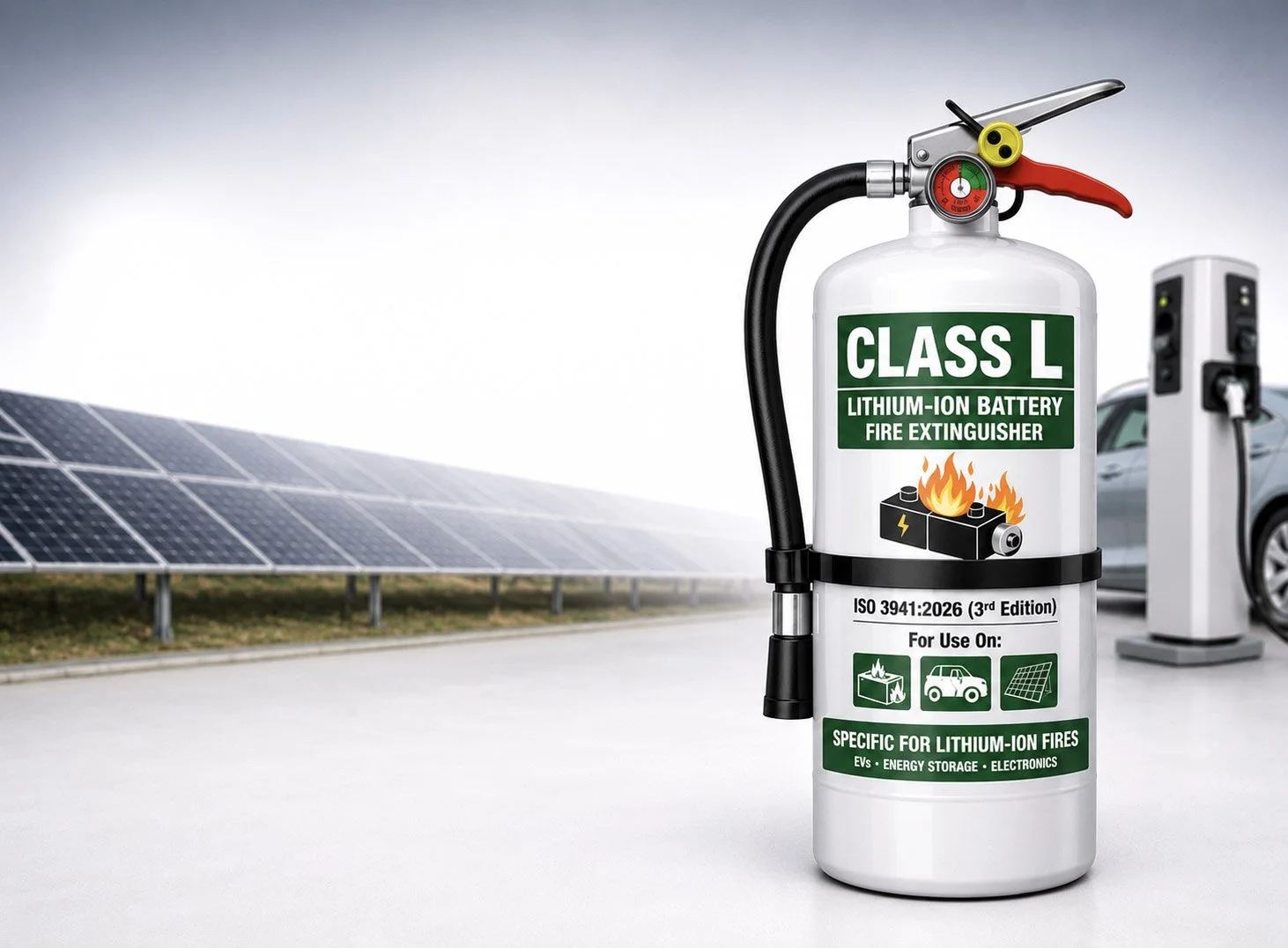
CLASS L
Lithium-Ion Batteries
Smartphones | Laptops | EV's | Power Tools | E-Scooters
The category “Class L” relates to all Lithium-Ion Batteries; think smart phones, laptops & electric vehicles. Due to the thermal runaway risk, the category “class L” was created to scope these types of fires.
Required: Water-based extinguisher with F-500 encapsulator agent to suppress thermal runaway and cool internal battery components
CLASS D
Metallic Lithium
Industrial | Chemical | Manufacturing
Class “D” relates to metallic lithium which interacts differently during a fire. Metallic lithium burns at extreme temperatures. Water based extinguishers cannot be used on metallic lithium fires as it reacts violently to water.
Required: Dry powder agent (copper or sodium chloride) to smother the burning metal without causing an aggressive reaction.
Identifying which class applies to your site is the first step toward selecting appropriate fire protection equipment. Many Perth workplaces will face only Class L risks, but any facility that stores raw or unfinished battery materials may also carry a Class D exposure.
There are multiple acts, regulations, and standards that govern the storage, handling, and maintenance of lithium in the workplace, and these vary from sector to sector and state to state. It is worth noting upfront that the lithium industry — especially fire-related products — is currently undergoing rapid growth and change. The industry has moved faster than the standards reflect.
The two primary Australian Standards relevant to fire protection equipment are AS 2444 and AS 1851. Both require careful interpretation, because neither fully addresses current workplace lithium-ion battery situations.
| Standard | What It Covers | Current Gap | Key Clauses |
|---|---|---|---|
| AS 2444Portable Fire Extinguishers and Fire Blankets | Selection, location, and distribution of extinguishers. Includes Class D (metallic lithium) provisions. Uses a risk-based approach to hazard identification. | Does not contain specific guidance for lithium-ion (Class L) risks. Does not reference Class L suppression products entering the market. |
Cl. 4.1 Hazard selection
Cl. 4.2.2 & 4.3.2 Complementary protection
Cl. 3.9 Environmental factors
Cl. 4.4 Specific hazards
|
| AS 1851Routine Service of Fire Protection Systems | Routine inspection, testing, and maintenance of portable fire equipment throughout its service life. | No specific provisions for Class L extinguisher testing or maintenance. Manufacturers' instructions must be consulted for Class L equipment. |
F-500 units follow water extinguisher procedures under AS 1851
|
⚠️ Important for WA businesses: AS 2444 adopts a risk-based approach. Organisations managing significant quantities of lithium-ion batteries should not rely solely on minimum compliance requirements. Manufacturer guidance, insurance requirements, fire engineering advice, and emerging industry best practice should all inform your fire protection decisions.
AS 2444 governs the selection, location, and distribution of portable fire extinguishers and fire blankets in Australian workplaces. While the standard includes provisions for combustible metal fires (Class D), including lithium metal hazards, it does not currently contain specific guidance for lithium-ion battery fire risks, nor does it reference the growing range of Class L suppression and protection products entering the market.
This distinction matters because lithium-ion batteries present different hazards to lithium metal fires. As lithium-ion batteries continue to expand across workplaces, warehouses, vehicles, tools, energy storage systems, and consumer products, many businesses and property owners are actively seeking guidance on whether additional fire protection measures should be considered.
Although AS 2444 does not currently prescribe specific lithium-ion fire protection equipment, the standard does adopt a risk-based approach to the selection and placement of fire protection equipment. Provisions relating to hazard identification, complementary extinguisher protection, and environmental considerations recognise that additional protective measures may be appropriate where unique or elevated fire risks are present.
As a result, organisations managing significant quantities of lithium-ion batteries should not rely solely on minimum compliance requirements. Consideration should also be given to the nature of the battery risk, manufacturer recommendations, insurance requirements, fire engineering advice, and emerging industry best practice when assessing whether supplementary fire protection measures are warranted.
AS 1851 outlines the routine inspection, testing, and maintenance requirements for portable fire equipment throughout its service life. Similar to AS 2444, the current edition does not contain specific provisions for the testing, maintenance, or servicing of lithium-ion battery extinguishers or emerging Class L fire protection equipment.
Many Class L products have entered the Australian market without corresponding testing and maintenance requirements being incorporated into existing Australian Standards. As a result, there is currently limited guidance within AS 1851 regarding the ongoing inspection and maintenance of these specialised extinguishers. This is particularly important given that testing requirements may vary between manufacturers, extinguishing agents, and extinguisher designs.
Where Australian Standards do not provide specific testing procedures, manufacturers' instructions should be consulted to determine the appropriate inspection, maintenance, and servicing requirements for the equipment. For example, in the case of F-500 encapsulator agent extinguishers marketed for lithium-ion battery fire applications, the manufacturer advises that routine inspection and maintenance can generally follow the same procedures applied to stored-pressure water extinguishers under AS 1851. This is because the F-500 agent is contained within a water-based extinguisher platform, meaning the physical inspection, pressure checks, and servicing requirements remain largely consistent with those prescribed for water extinguishers.
As lithium-ion battery hazards become more prevalent across Australian workplaces, future revisions of Australian Standards are expected to provide greater clarity regarding the selection, testing, and maintenance of lithium-ion-specific fire protection equipment. Until then, businesses should rely on a combination of Australian Standards, manufacturer guidance, risk assessments, and professional fire protection advice when determining appropriate maintenance requirements.
With lithium-ion batteries now common across Perth workplaces, certain industries face significantly greater exposure to battery-related fire risks. Any facility that stores metallic lithium or holds significant quantities of lithium-ion batteries or battery-related products should begin formally assessing the associated risks.
Warehouses storing battery-powered products, distribution centres operating electric forklifts, EV charging facilities, e-scooter and e-bike rental operators, trades businesses using rechargeable power tools, mining operations and facilities housing battery energy storage systems all rely heavily on lithium-ion technology. Any facility that stores any metallic lithium or has stores of lithium ion batteries or battery related products should begin to assess the risks associated.
While AS 2444 and AS 1851 provide guidance for the selection, installation, inspection, and maintenance of portable fire equipment, they currently contain limited provisions specifically addressing lithium-ion battery fire protection equipment. This has created growing interest from Perth businesses seeking to understand their obligations and whether additional fire protection measures are appropriate for their environment.
As lithium-ion battery use continues to expand, regular fire extinguisher testing, fire equipment maintenance, and compliance inspections throughout Perth remain important components of workplace fire safety. Businesses should ensure fire protection equipment is maintained in accordance with applicable Australian Standards while also considering manufacturer recommendations, site-specific hazards, and emerging industry best practice.
CO2, dry powder, and standard water extinguishers are not designed to cool a battery's internal cells or suppress thermal runaway. Using the wrong extinguisher can allow a battery fire to reignite after it appears extinguished.
Class L fires (lithium-ion) require an F-500 water-based extinguisher. Class D fires (metallic lithium) require dry powder. The wrong choice in a fire event can escalate the hazard significantly.
High ambient temperatures can accelerate battery degradation, particularly where batteries are poorly ventilated, incorrectly charged, damaged, or not maintained in accordance with manufacturer recommendations.
Where Australian Standards do not provide specific procedures, manufacturers' instructions should be consulted to determine appropriate inspection, maintenance, and servicing requirements for Class L fire protection equipment.
Because Australian Standards currently lag behind the lithium-ion fire risk landscape, ticking the compliance box alone is not enough. The following factors should inform how your business approaches fire protection for lithium battery risks.
For lithium-ion battery fires (Class L), you need a water-based extinguisher filled with F-500 encapsulator agent. This suppresses thermal runaway and cools the battery's internal components. For metallic lithium fires (Class D), you need a dry powder agent such as copper or sodium chloride powder. Water must never be used on metallic lithium fires as it reacts violently.
Thermal runaway occurs when a lithium-ion battery rapidly overheats, triggering an uncontrollable chemical reaction inside its cells. It produces extreme heat, violent flare-ups, toxic gases, and repeated re-ignition, even after the fire appears to be extinguished. This is what makes lithium battery fires so much harder to control than typical electrical or combustible fires.
Not specifically. AS 2444 covers extinguisher selection and includes Class D (metallic lithium) provisions, but does not contain specific guidance for lithium-ion battery fire risks. AS 1851 covers routine maintenance but similarly lacks specific provisions for Class L equipment. Both standards adopt risk-based approaches, so businesses should supplement compliance with manufacturer guidance and professional fire protection advice.
The highest-risk industries in Perth include warehouses storing battery-powered products, distribution centres operating electric forklifts, EV charging facilities, e-scooter and e-bike rental operators, trades businesses using rechargeable power tools, mining operations, and facilities housing battery energy storage systems (BESS) or solar battery installations.
Yes. PTTS can assess your current fire protection arrangements and review whether your existing fire equipment is appropriate for your environment. We provide professional fire extinguisher testing, fire equipment maintenance, and compliance inspections throughout Perth. Contact us to arrange a review.
If your workplace stores, charges or operates lithium-ion battery equipment, Perth Test and Tag Solutions can assess your current fire protection arrangements and review whether your existing fire equipment is appropriate for your environment.
We provide professional fire extinguisher testing, fire equipment maintenance and compliance inspections throughout Perth.